The best ASMR for sleep is slow, even and long. No-talking sound videos, gentle whispering, soft-spoken voices, slow tapping, brushing, rain soundscapes and all-night videos are the types most worth trying, as long as nothing in them jumps out at you.
There's no single winner, because triggers differ from person to person. Below, each type gets a short guide to who it suits and what to look for, followed by a live row of videos.
Those rows aren't a fixed list someone picked in 2020. They're pulled live from the Tingly Room catalogue each time the page loads, so they refresh as new videos are added. Tingly Room is a free ASMR video finder: no ads of its own, no third-party trackers, and videos play in YouTube's official player, so views count for the creator.
What makes an ASMR video good for sleep?
Most ASMR fans already use it at bedtime. In the first peer-reviewed ASMR survey, of 475 people who experience it, 82% said they watched to help them sleep and 81% said they most often watched before going to sleep at night (Barratt & Davis, 2015).
But not every ASMR video is sleepy. A University of Sheffield study found that ASMR lowered heart rate by about 3.4 beats per minute in people who experience it, while skin conductance rose slightly; the authors described ASMR as calming but also activating (Poerio et al., 2018). For bedtime, you want the calming side and as little of the activating side as possible.
In practice, a good sleep video has:
- A slow, steady pace. Repetition beats variety at night.
- Even volume. No loud intro, no sudden bang, no outro jingle.
- Enough length. Ideally longer than it takes you to fall asleep, so nothing ends and jolts you awake.
- Sounds you like. A trigger that annoys you won't relax you, however popular it is.
The best types of ASMR for sleep
1. No talking
Pure sound with no voice: tapping, brushing, crinkles, page turning, object sounds. With no words, there's nothing to follow or understand, which suits a tired brain.
Good for: people who find voices distracting, light sleepers, anyone new to ASMR who isn't sure about whispering.
Look for: one or two sounds repeated slowly, rather than a fast "trigger assortment" that switches every few seconds. You can browse the full no-talking ASMR category.
2. Whispering
The classic ASMR sound. Whispering was the most common trigger in the Barratt & Davis survey, named by 75% of participants (Barratt & Davis, 2015).
Good for: people who already know whispering gives them tingles or calms them down.
Look for: a steady, low whisper. Close, ear-to-ear whispering can feel intense; if it wakes you up rather than settles you, try a more distant or quieter style.
3. Soft-spoken
A calm, quiet speaking voice rather than a whisper, a bit like being read to. In the Sheffield study's online sample of people who experience ASMR, soft speaking was the most commonly reported trigger, at 74% (Poerio et al., 2018).
Good for: people who find whispering too close or too breathy, and anyone who falls asleep to podcasts or audiobooks.
Look for: a slow, even delivery and a low-stakes topic. A story with a gripping plot can keep you listening instead of drifting.
4. Slow tapping
Fingernails on wood, glass, plastic or a book cover. Crisp sounds like these were the third most common trigger in the Barratt & Davis survey, at 64%.
Good for: people who like crisp, textured sound and don't need a voice.
Look for: slow, rhythmic tapping. Fast and unpredictable tapping is great for tingles in the afternoon but can keep you alert at night.
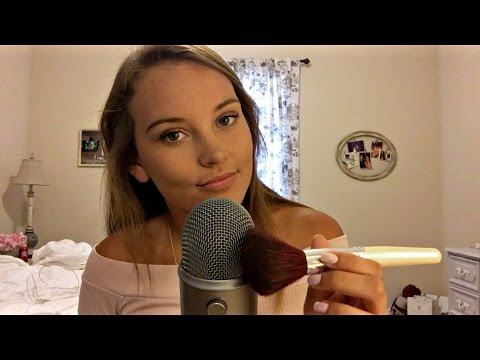
5. Brushing
Soft brushes on the microphone, on fabric, or on the camera lens. Hair play and brushing came a close second in the Sheffield study's trigger list, at 73% (Poerio et al., 2018).
Good for: people who want something softer and more continuous than tapping.
Look for: long, slow strokes. Mic brushing can get loud on cheap headphones, so check the volume before you lie down.
6. Rain and soundscapes
Rain, fireplaces, quiet rooms and nature recordings sit between ASMR and background noise. They're the easiest entry point if whispering isn't for you, and they help cover a noisy street or a snoring partner.
Good for: people who sleep with a fan on, or who don't feel tingles at all.
Look for: a steady recording without thunder claps or sudden changes. If you're weighing this against a white noise machine, see white noise vs ASMR.
7. Long and all-night videos
A 15-minute video that ends with a click, or autoplays into something loud, can wake you right back up. Long videos remove that risk: on Tingly Room, "long" means 30 to 60 minutes, "extended" one to three hours, and all-night videos run 3 hours or more.
Good for: anyone who wakes up when the sound stops, or who wants something to restart after waking at night.
Look for: a video that stays in one style the whole way through. Use a sleep timer anyway, so audio doesn't play into your ears all night.
8. Personal attention
Videos where the creator talks to you as if you were in the room: a calm check-in, a gentle exam, someone getting you ready for bed. Personal attention was named by 69% of participants in the Barratt & Davis survey.
Good for: people who feel wound up or alone at night and find a calm, caring voice reassuring.
Look for: low-key, slow roleplays. Skip ones with lots of dialogue, plot twists or bright props if you're using them to fall asleep.
How to choose: voice, pace and length
If you don't know where to start, match the video to how you feel at bedtime.
| If you... | Try first |
|---|---|
| Get distracted by words | No talking, slow tapping, brushing |
| Like being read to | Soft-spoken |
| Already get tingles from whispers | Whispering |
| Need to cover outside noise | Rain and soundscapes |
| Wake up when sound stops | Long or all-night videos |
| Feel anxious or lonely at night | Personal attention, soft-spoken |
Voice
Voice is the biggest split. Some people relax only with no voice at all; others need a human voice to feel settled. In the Sheffield study, the soft-spoken videos scored slightly higher for calm than the sound-only ones, but the gap was small and the authors didn't test it as a head-to-head comparison (Poerio et al., 2018). Your own reaction is the better guide.
Pace
For sleep, choose slow and gentle. Save fast, aggressive and unpredictable videos for when you want tingles, not sleep.
Length
Pick a video that's clearly longer than it usually takes you to fall asleep. If you tend to wake at night, an all-night video means you can press play again without picking something new on a bright screen.
Settings that matter as much as the video
Use a sleep timer and turn off autoplay
A timer stops playback once you're likely asleep. Check whether your phone's clock app or your media app has one, and switch off autoplay so the next video doesn't start on its own.
Keep the volume low
Set the volume as low as you can while still hearing the details, and do it before you lie down. Sounds at or below 70 dBA are unlikely to cause hearing loss even after long exposure, while long or repeated exposure at 85 dBA or more can; headphones at maximum volume reach 94 to 110 dBA (NIDCD).
Speaker or headphones?
- A speaker or phone on the nightstand is the simplest option if you sleep alone. Nothing presses into your ears, and the sound fades naturally into the room.
- Headphones keep the sound to yourself if you share a bed, and they bring out the left-right detail many ASMR videos are recorded for. Hard earbuds can hurt if you sleep on your side; soft headband-style sleep headphones are an alternative.
Keep the screen dark
The CDC recommends turning off electronic devices at least 30 minutes before bed, and Mayo Clinic notes that evening light can make it harder to fall asleep. Treat ASMR as audio: choose the video, start it, turn the brightness down and put the phone face down.
For a full bedtime routine built around these settings, see how to use ASMR to fall asleep.
How to find your best type
- Pick two or three types from the list above that sound appealing.
- Give each a few nights. One night tells you little; a new sound can feel odd at first.
- Keep everything else the same: same timer, same volume, same bedtime.
- Notice how you feel, not just whether you got tingles. Half of the Barratt & Davis participants said ASMR lifted their mood even in sessions without tingles.
- Drop anything that irritates you. Mouth sounds, for example, relax some people and bother others.
On Tingly Room's video finder, you can combine these choices: pick "sleep," then a voice, a pace and a length, and see only the videos that match. The sleep ASMR category is a good place to browse.
What ASMR can and can't do for sleep
ASMR may help you relax enough to fall asleep, and it's low risk at a sensible volume. The evidence is still early, though. The surveys above describe how fans use it, not whether it works, and direct sleep studies are scarce. A small 2024 preprint, not peer reviewed, gave 60 high school students ASMR audio before bed for five days and found mixed results: some change in app-measured sleep duration, but no significant effect on sleep efficiency or self-rated sleep quality (medRxiv, 2024).
ASMR isn't a treatment for insomnia. If you struggle to sleep at least three nights a week for three months or more, that meets the definition of chronic insomnia, and the American College of Physicians recommends cognitive behavioral therapy for insomnia (CBT-I) as the first treatment (ACP, 2016). Talk to a doctor if poor sleep is wearing you down; you can keep using ASMR to relax alongside treatment.
If your problem is waking at night rather than falling asleep, read what to do when you can't sleep.