
ASMR YouTubers make anything from nothing to a full-time living, and no honest single number exists. One thing is fixed: YouTube's split. Creators in the Partner Program get 55% of net ad revenue on long-form videos. Everything else depends on how many views carry ads, who is watching and where they live.
The handful of ASMR creators who have given reporters real figures described a modest living. Not a fortune. Here is what's known, what isn't, and how to read the numbers floating around online.
The short answer, with real figures
Very few ASMR creators publish their income, so the reliable data is thin. This is what has been disclosed in reputable press:
| Creator | What they disclosed | Source |
|---|---|---|
| Olivia Kissper | More than $1,000 a month from Patreon, plus around $1,000 from YouTube | Business Insider, 2018 |
| Massimo Tarantelli (ASMR Barber) | About $2,000 a month from his channel | Business Insider, 2018 |
| Three full-time ASMR YouTubers (unnamed) | Around $2,000 a month, from YouTube, Patreon and other income | Business Insider, 2018 |
| Maria (Gentle Whispering ASMR) | Declined to give a figure; said it was enough for a comfortable living after quitting her day job | CNBC, 2017 |
These figures are old, and the sample is small. They still show a pattern that holds today: the creators who made a living paired YouTube with something else, usually Patreon.
The same Business Insider piece mentions a creator whose YouTube income dropped to a quarter of what it had been after YouTube changed its advertising model. Ad money can swing hard without the creator changing a thing.
For most people, the number sits close to zero. In a 2022 Linktree survey of 9,500 creators across every niche, 46% of full-time creators earned under $1,000 a year (TechCrunch, 2022).
How YouTube pays ASMR creators
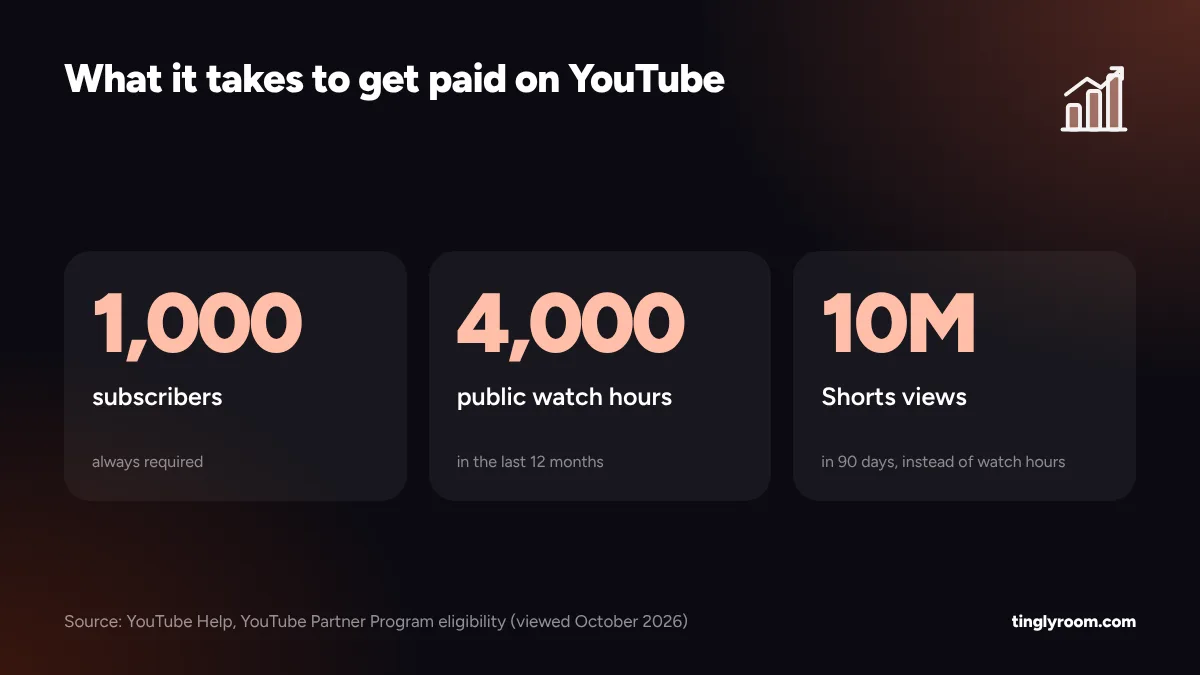
YouTube pays nothing until a channel joins the YouTube Partner Program. Getting in takes 1,000 subscribers plus either 4,000 public watch hours in the last 12 months or 10 million Shorts views in 90 days, along with an AdSense account and no active strikes (YouTube Help).
Once you're in, YouTube's published split looks like this (YouTube Help):
| Revenue type | Creator's share |
|---|---|
| Ads on long-form videos | 55% of net revenue |
| Ads in the Shorts feed | 45% of the revenue allocated to you by share of views |
| Memberships, Super Chat, Super Stickers, Super Thanks | 70% of net revenue |
Premium subscribers count too: when one of them watches your videos, you get part of their fee (YouTube Help). YouTube finalizes the previous month's earnings between the 7th and 12th, and pays between the 21st and 26th once your balance clears the local threshold. Google also withholds US tax on earnings from US viewers.
RPM vs CPM: what an ASMR view is actually worth
Two numbers get confused all the time, and only one of them is your income. YouTube defines them like this (YouTube Help):
- CPM is what advertisers pay per 1,000 ad impressions, before YouTube takes its share.
- RPM is what you earn per 1,000 video views, after YouTube's share. It includes ads, Premium, memberships, Super Chat and Super Stickers, but not sponsorships or merch.
RPM is the one that pays your rent, and it always comes in below CPM. It's calculated after the revenue share, and it counts every view, including the ones where no ad played. YouTube lists what moves it: where viewers live, whether a video is advertiser-friendly, how many viewers have Premium, ad availability, and how many ads a viewer has seen lately.
Why we don't quote an "ASMR RPM"
You'll find pages quoting a precise RPM for ASMR. We couldn't find one that traces back to creators' actual analytics or to a reputable outlet. Most "ASMR YouTuber net worth" pages take public view counts and multiply them by a guessed rate. Treat those numbers as what they are: guesses.
The honest version is less exciting. Your RPM shows up in YouTube Studio once you're monetized, and it will differ from the next channel's, sometimes by a lot.
Why sleep videos change the math
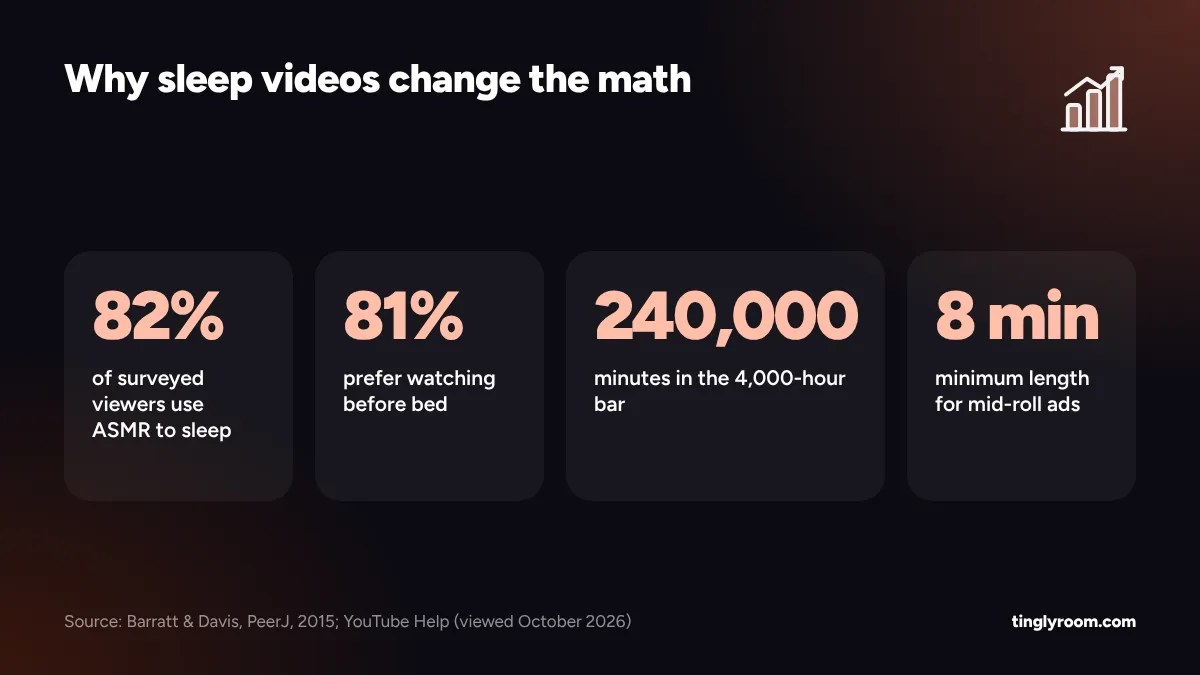
ASMR has one odd feature that shapes the money: people fall asleep to it. In the first large survey of ASMR viewers, 82% used it to help them sleep and 81% preferred watching before bed (Barratt & Davis, 2015).
Watch hours pile up faster. The 4,000-hour bar is 240,000 minutes, and a three-hour video left running all night does far more for it than a 10-minute clip someone finishes. Browse 3-hour-plus ASMR to see the format in action.
Long videos can also carry more ads. Mid-roll breaks are only possible on monetized videos of 8 minutes or longer, and automatic slots stay on unless the creator switches them off (YouTube Help). A slot is not a guaranteed ad, though.
Here is the catch. A mid-roll that blares into a quiet sleep video can wake the viewer and cost you a subscriber. You can place breaks by hand at natural pauses, or untick the automatic slots. Our piece on ads and sponsors in ASMR videos covers the trade-off from the viewer's side of the screen.
Views are not income
A million views can pay very differently on two channels. Views without ads still count in RPM, so they drag it down. Shorts views pay from a separate pool at a lower share. And a channel outside the Partner Program earns nothing from ads at all, however many views it racks up.
An illustrative example (made-up numbers)
To show how the pieces fit, take a hypothetical channel with an RPM of $3. That figure is invented for the arithmetic. It is not a typical ASMR rate.
- 100,000 long-form views × $3 per 1,000 = $300.
- Change the audience or the ad settings and the RPM moves. At an invented $1.50, the same views pay $150.
- The same channel's 100,000 Shorts views would be paid from the Shorts pool instead, under different rules.
The dollar amount is beside the point. Income is views multiplied by a rate you only learn from your own analytics, and that rate shifts from month to month.
Where the rest of an ASMR income comes from
AdSense is rarely the whole story. Patreon charges new creators a 10% platform fee plus processing (Patreon Help), and pledges arrive whether or not advertisers are bidding that month. Sponsorships get negotiated one deal at a time. Paid custom ASMR videos are another route: on Tingly Room, creators who verify their YouTube channel set their own price and keep 85% of each request.
All eight income streams, with what each platform keeps, are laid out in how to make money with ASMR.
The risk to an ASMR income
A channel can vanish overnight. In late July 2026, YouTube terminated several established ASMR channels, saying they had linked to content that breaks its nudity and sexual content policy (404 Media, 2026). One of those creators, Slight Sounds, said the channel had been her livelihood for eight or nine years (Dexerto, 2026).
Two lessons. Keep your channel and every link on it strictly SFW. And never let one platform hold all of your income.
FAQ
Do ASMR YouTubers get paid per view?
Not directly. YouTube pays a share of ad and subscription revenue, and RPM simply expresses that per 1,000 views. A view with no ad adds nothing to ad revenue.
How many views does it take to make $1,000 on YouTube?
It depends entirely on your RPM. Divide $1,000 by your RPM, then multiply by 1,000. At a hypothetical $2 RPM, that's 500,000 views; at $4, 250,000. Only your own analytics give you the real rate.
Do small ASMR channels earn anything?
Not from YouTube ads until they join the Partner Program. Before that, the money comes from outside: Patreon, custom requests or the occasional sponsor.
Who are the biggest ASMR YouTubers?
See our list of the best ASMR channels. Subscriber counts are public. Income almost never is.
Want to see where the views go?
Most surveyed ASMR viewers watch at bedtime, so study what they pick at night. Browse sleep ASMR by trigger, voice and length on Tingly Room.


